
The Embedded Cofounder Method, explained in four phases
After more than 200 client engagements, we noticed something. People rarely got stuck because they lacked talent or worked too little. They got stuck because they did the right things in the wrong order.
They built a website before they knew who it was for. They posted every day before they had a clear offer. They paid for ads before they had sold the offer even once by hand.
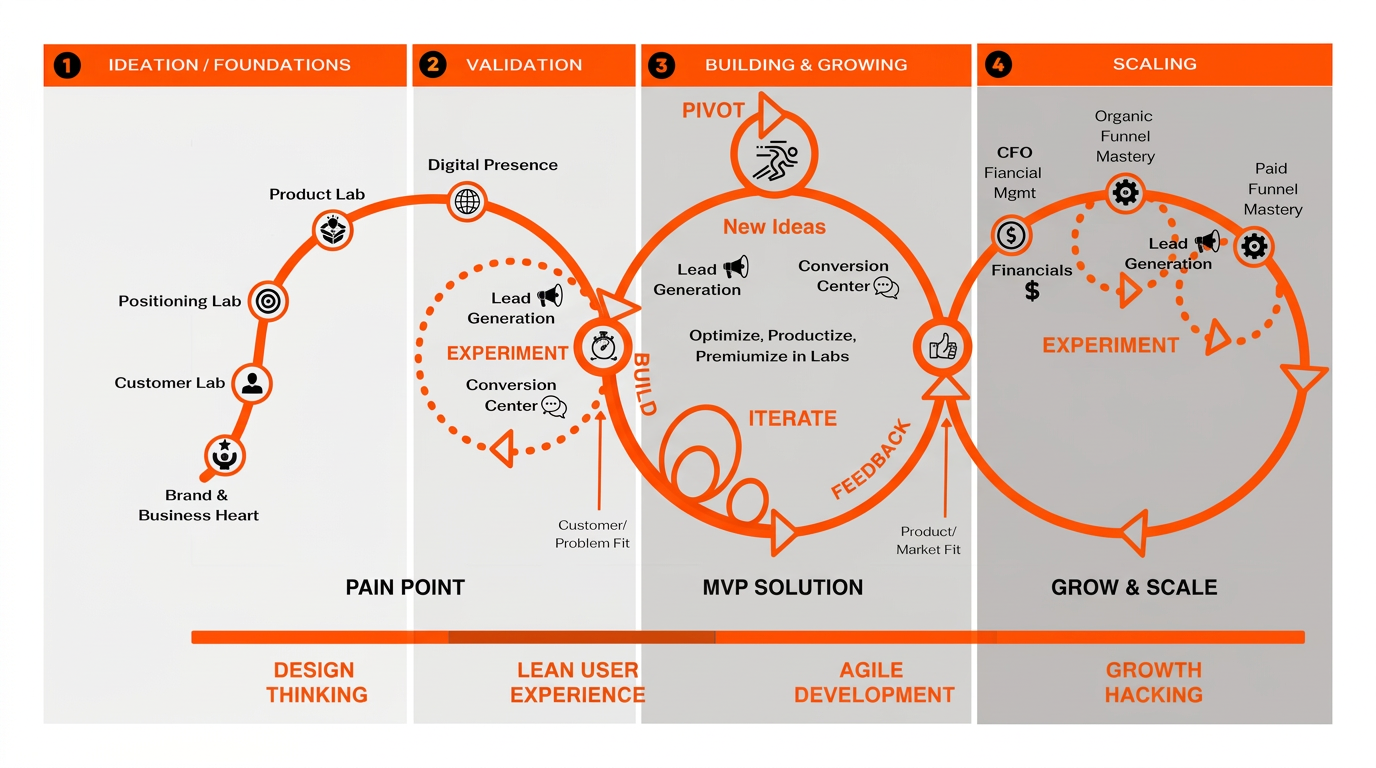
So we wrote down the order. We call it The Embedded Cofounder Method™. It has four phases, and each one borrows from a way of working that big product teams have used for years.
The thinking behind the sequence
Steve Blank's The Four Steps to the Epiphany gives this sequence its customer-development logic: test assumptions with customers before committing to a build. We adapt that logic for coaches, consultants and fractional leaders.
Our working principle is simple: customer evidence before strategy, strategy before content, content before scale. Early ideas are useful, but they're still guesses.
The four phases describe the sequence over time. The five pillars describe what your practice needs to run: positioning, offer, content, outreach and follow-up. Foundations and validation shape the first two. Building brings the others online. Scaling improves the whole system.
These are established practitioner frameworks, not scientific proof that our tool will produce a particular result. This article explains our process. It isn't the methodology whitepaper.
Phase 1: Ideation and foundations
Borrowed from: Design Thinking
This is where you decide who you're for and what you'll help them with. Design Thinking starts with the person, not the product, and so do we.
You start with yourself: your career, your values, what you're really good at and what you want your work life to look like. In the tool, this is the Brand & Business Heart, a 13-part intake that becomes the foundation for everything else.
Then you look outward. Who might have the problem you solve best? You draft an ideal client hypothesis to investigate in the next phase.
Ash Ali and Hasan Kubba's The Unfair Advantage informs this opening step. Their MILES framework examines money, intelligence, location, education and status. We use that lens to look for useful assets in your career, rather than starting with a generic positioning template.
At the end of this phase you have a hypothesis, which is a smart guess. You don't have proof yet. That's fine. You're not supposed to.
Phase 2: Validation
Borrowed from: Lean UX
Lean UX is about testing ideas cheaply before you spend real money on them. For a solo practice, that starts with discovery conversations.
In Customer Lab, you investigate the client's problem before treating your first guess as settled. Positioning Lab turns those findings into a positioning statement. Product Lab helps shape an offer around what you've learned.
Rob Fitzpatrick's The Mom Test informs the interview approach. Ask about specific past experiences, current workarounds and decisions people have already made. "Would you buy this?" can invite a polite answer. What someone tried last month gives you something more concrete to work with.
This phase is a loop. You listen, compare what people say and revise your assumptions. Look for evidence of a real problem and willingness to pay, rather than collecting compliments.
The goal of this phase has a name: customer/problem fit. It means you've gathered evidence that the intended clients have the problem and see value in solving it. Positive interviews alone don't prove they'll buy.
Alex Hormozi's $100M Offers informs the offer work here. Its Value Equation asks you to consider the desired outcome, confidence in reaching it, waiting time and effort. We use those questions to examine the offer, not to promise income.
Phase 3: Building and growing
Borrowed from: Agile Development
With evidence behind your positioning and offer, you can build the systems that bring them to market. Agile teams build in small steps, get feedback, and build again. You do the same with your offer and your process.
Digital Presence carries your message onto your profile and website. Lead Generation supports content and outreach. Conversion Center helps you track conversations and follow-up.
Allan Dib's The 1-Page Marketing Plan treats marketing as a journey that continues after first contact. That informs our decision to make follow-up a named pillar. A reply needs a next step, not just a place in an inbox.
You listen to what clients say, you improve the offer, and you make it easier to deliver. Sometimes you change direction. We call that a pivot, and it's not a failure. It's what the feedback is for.
Three words describe this phase well: optimise, productise, premiumise. Make the offer work better, make it repeatable, and then make a premium version for the clients who want more.
The goal here is product/market fit: an offer that sells regularly, to the same kind of person, at a price that works for you.
Phase 4: Scaling
Borrowed from: Growth Hacking
Only now does it make sense to pour fuel on the fire. Growth Hacking means running many small experiments to find what grows the business fastest.
This is where you get serious about your numbers: what each client is worth, what each channel brings in, and where your money goes. Financials supports the financial side of that work. Improve the channels that already bring useful conversations before increasing activity. Paid advertising isn't a built-in capability we're claiming here.
Most people want to start here. It's the most exciting phase. But scaling something that isn't working just gets you to the wrong place faster.
Why the order matters so much
Every phase produces something the next phase needs. Your positioning makes your content specific. Your content makes your outreach warmer. Your sales conversations show you what to fix in your offer. Skip a phase, and the next one has nothing to stand on.
That's also why we call it an embedded cofounder method. A good cofounder doesn't just hand you a plan. They sit next to you and make sure you do things in the right order, especially when you're tempted to skip ahead.
In mettaCofounder.ai, your positioning, voice, ideal client profile and offers carry across modules, so later work has a shared foundation. Software does the daily work and you steer it. A weekly live call hosted by Carsten or Olga is included on every paid plan, giving you a place to question the next step.
Our experience comes from agency engagements, where we developed and refined the method. Those engagements aren't evidence of subscriber results from this tool. The frameworks explain our design choices; they don't guarantee outcomes or imply endorsement by their authors.
Where you are right now
Here's a quick way to tell:
- No paying clients yet, or only from your network? You're in phase 1 or early phase 2.
- Some clients, but each deal feels different and custom? You're in phase 2, looking for customer/problem fit.
- The same offer sells again and again? You're in phase 3.
- Steady income and you want more of it without more hours? You're ready for phase 4.
Be honest with yourself here. Knowing your phase tells you what to ignore, and ignoring the right things saves you months.
Want the system to run this for you?
mettaCofounder.ai is your marketing and sales team, on subscription. Software does the daily work, you steer it, and you meet us on a live call every week.
Join the free betaSources behind the steps
- Steve Blank, The Four Steps to the Epiphany: customer development and testing assumptions before building.
- Ash Ali and Hasan Kubba, The Unfair Advantage: the MILES lens used in foundations.
- Rob Fitzpatrick, The Mom Test: discovery questions grounded in actual behaviour.
- Alex Hormozi, $100M Offers: the Value Equation used to examine an offer.
- Allan Dib, The 1-Page Marketing Plan: the customer journey and the importance of follow-up.
Keep reading

Why "find your why" isn't enough, and what to build instead
A purpose statement on the wall doesn't change what you sell or who buys it. The Brand & Business Heart does. Here's the difference.

We ran an agency. Here's why agencies often fail solo experts
Hiring an agency sounds like the easy way out. After 200+ client engagements on the agency side, here's what we saw go wrong, and what to do instead.
How 200+ agency engagements built the tool, and keep improving it
Most marketing tools are built by people who've never run a client engagement. Ours is built by an agency that runs them every week.
READY WHEN YOU ARE
Hire your marketing and sales team.
Free during the beta. Launch pricing starts 1 November.
Or start free with your LinkedIn analysis. Email only, no card, no time limit.